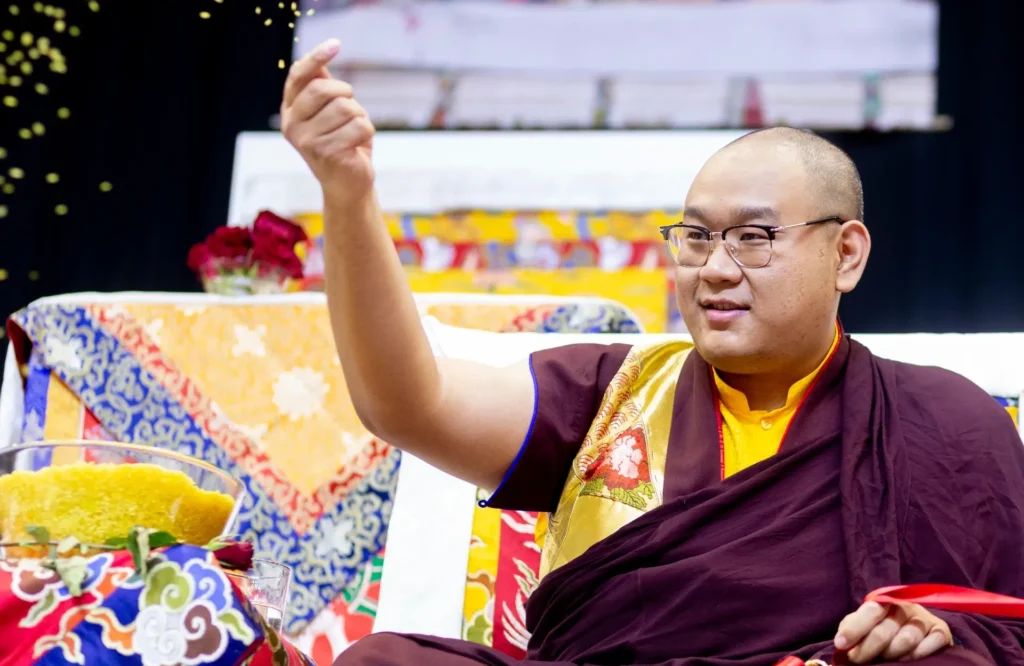
The IV. Jamgon Kongtrul Mingyur Drakpa Senge was born on December 17, 1995, in the Kathmandu Valley, the son of Beru Khyence Rinpoche.
Jamgon Yangshi began reading books at the age of five and memorized the rituals and practices of his own spiritual tradition. He received numerous Vajrayana empowerments, mainly in the Karma Kagyu tradition, as well as other practices related to guru meditation. He also received teachings, transmissions, and oral instructions on the practice of Mahamudra.
In December 2016, he received the red Dharma crown, the symbol of the most important Kagyu lineage holders, from the XVII. Karmapa at the ancient Karma Kagyu monastery in Bodhgaya, India, the site of Buddha’s enlightenment.
In October 2018, Rinpoche began the traditional three-and-a-half-year retreat in Pharping, near Kathmandu, during which the deepest teachings of the tradition are put into practice by the retreatants, and on May 4, 2022, they successfully completed the retreat.
Since then, Rinpoche has continued to give teachings and empowerments in several Asian countries, and in the summers and autumns of 2024 and 2025, he undertook European tours lasting several months. At the request and upon the persistent urging of his disciples, he will continue the Dharma activities he began at the European centres in 2026.
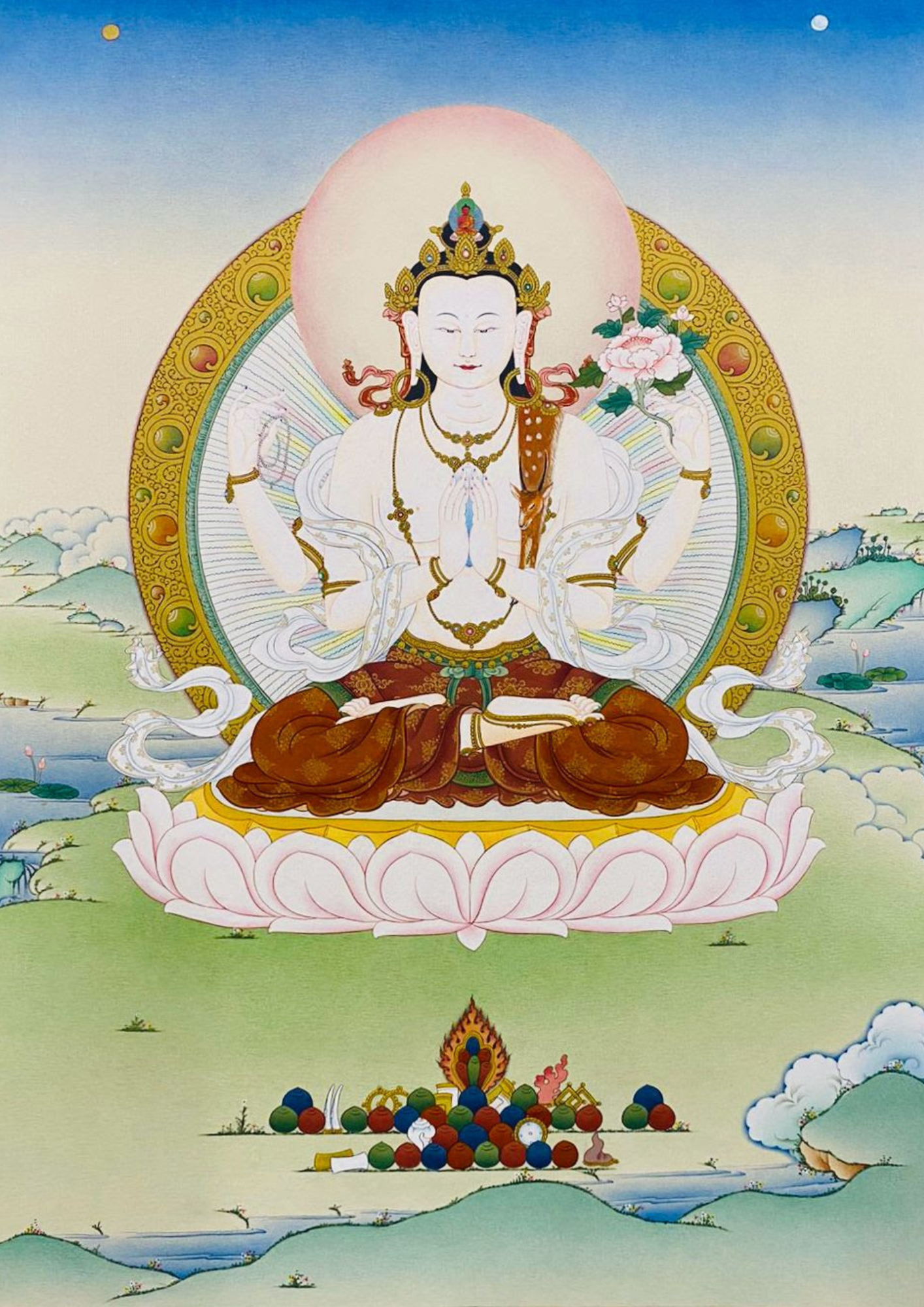
The transmission of this empowerment reaches us through Thangtong Gyalpo, the great siddha and bridge-builder who was held to be Chenrezig himself appearing in human form. The practice he set down, Extending Throughout Space for the Benefit of Beings (Drowa Kunkyab), was not composed by an ordinary author: as the XV. Karmapa Khakhyab Dorje states plainly, it was composed by Chenrezig, who came to help beings in the guise of Thangtong Gyalpo. From him the transmission passed in an unbroken line through the Karma Kagyu, whose lineage holders, the Karmapas, are themselves regarded as emanations of Chenrezig, down to His Eminence the IV. Jamgon Kongtrul Rinpoche.
Noble Chenrezig
Chenrezig is the Buddha of Compassion, arisen as the manifest expression of the consummate compassion of all the buddhas. Among all the Victorious Ones, his mind of awakening and his enlightened activity are the most excellent: rather than resting in the peace of meditative absorption, he works ceaselessly, throughout past, present and future, to guide the beings of the six realms until samsara itself has been emptied. In him the aspirations of every buddha and bodhisattva are gathered into one unified essence, and each of their compassionate deeds finds its own expression in his being. As Buddha Shakyamuni prophesied, Tibet became his particular field of activity, where he has appeared as king and minister, translator and scholar, siddha, and simple child. Such is the force of his blessing that small children there have been known to speak the six syllables without ever having been taught them.
His six syllables, OM MANI PADME HUM, dispel suffering far and wide. Each syllable is the essence of one of the six perfections, each is the radiance of one of the wisdoms, and each reaches into one of the six realms to clear away the particular anguish that binds the beings who live there.
The result of the practice
The empowerment ripens the practitioner for a practice whose fruit is a complete turning of ordinary experience. Everything that appears — earth, rock and mountain, one’s own body and the bodies of others — is seen as the form of the Great Compassionate One. Every sound, whether speech or the noise of the world, resounds as the six syllables. Every thought is the unfabricated expanse of awareness-emptiness, the mind of the Noble One himself. The world one inhabits is no longer an ordinary place but Dewachen, the Realm of Joy. Carried to its end, the practice brings one to the very state of Chenrezig, and with it the power to establish all beings, without a single exception, in that same state.
The XV. Karmapa, Khakhyab Dorje
The manual we rely on for this practice, Continual Rain for the Benefit of Beings, was written by the Fifteenth Gyalwa Karmapa, Khakhyab Dorje (1870–1921), one of the great masters and lineage holders of his age, whose disciples carried the Karma Kagyu into the twentieth century. Asked repeatedly by a devoted practitioner and her mother to compose such a text, he distilled the whole of the meditation and recitation into a few clear pages, taking care, as he says, to write so that a simple layman could understand it. He signed it as an ailing old beggar who merely pretends to be a bodhisattva in a degenerate age. That combination — complete mastery of the material and complete absence of self-regard — is itself an instruction, and it is his voice that guides anyone who takes up this practice today.
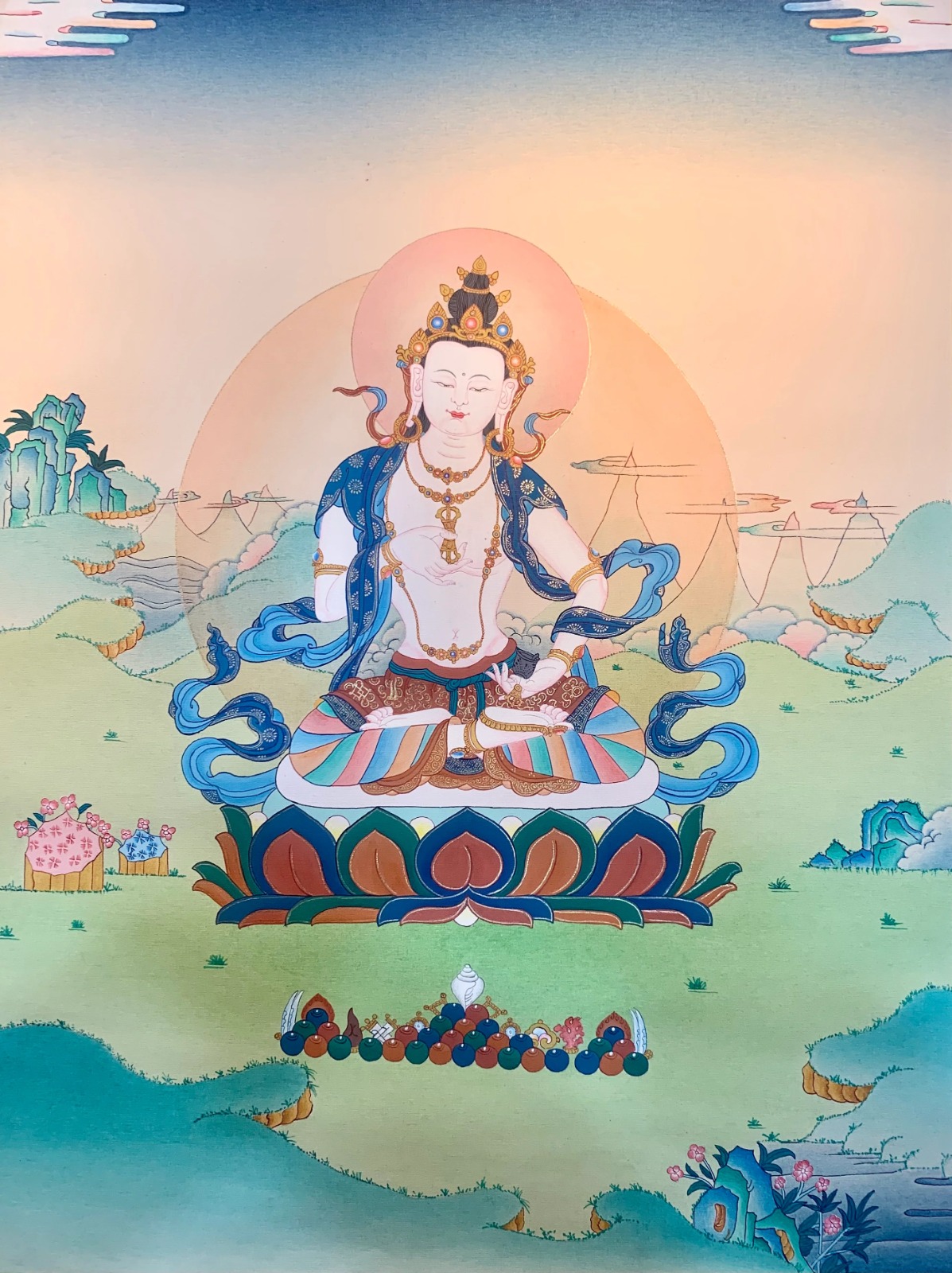
Vajrasattva is one of the most important purification practices of Vajrayana Buddhism. It is a profound tantric method for purifying negative karma, harmful actions, habitual patterns, and the obscurations that veil the naturally awakened nature of mind. Through visualization, mantra, confession, and the four powers, the practitioner engages directly with the causes and conditions that give rise to suffering and obstruct spiritual realization.
Vajrasattva therefore holds a particularly important place within the tantric path. The practice is not simply about removing something regarded as permanently impure. Rather, it reveals that karmic obscurations and negative patterns are themselves empty of inherent existence. Through the practice, this understanding is gradually brought from an intellectual level into direct experience.
In the Karma Kagyu tradition, Vajrasattva is also a central practice of the uncommon preliminary practices — the ngöndro — where it forms the purification section of the path. Following refuge and bodhicitta, the practitioner uses Vajrasattva meditation and mantra to purify accumulated karma and obscurations, preparing the ground for the subsequent practices of merit accumulation and guru yoga.
Receiving the Vajrasattva empowerment provides the authorization, transmission, and blessing to engage in this particular tantric meditation practice within the lineage. It is therefore especially meaningful for those undertaking or preparing to undertake ngöndro, while also being a profound introduction to the methods and view of Vajrayana Buddhism.
No previous experience is required; what is needed is genuine interest, respect for the practice, and an openness to receive the transmission.
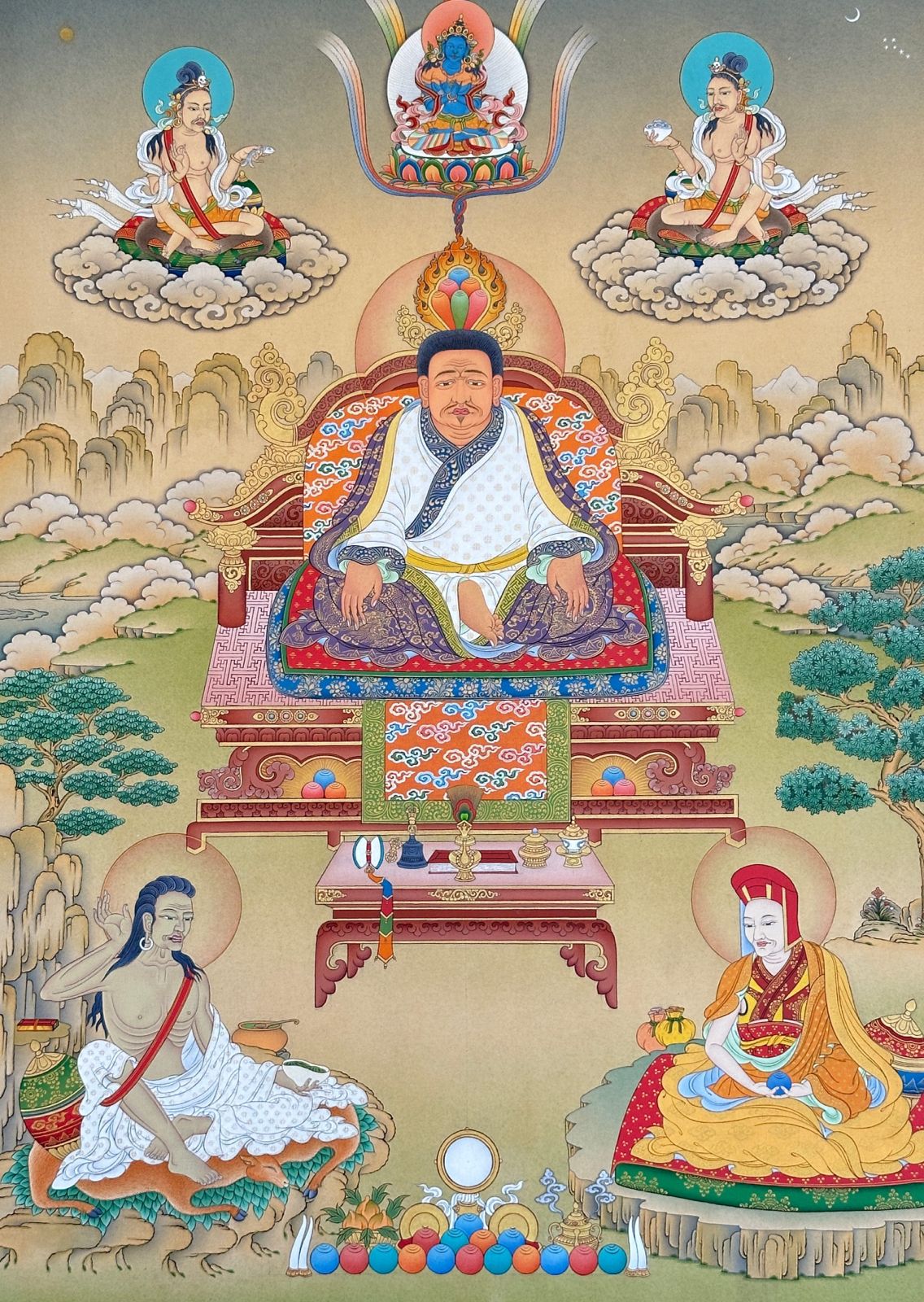
Marpa Lotsawa, also known as Marpa Chökyi Lodrö (1012–1097), was one of the most important masters of Tibetan Buddhism and the founder of our tradition, the Kagyu lineage.
He was born in Tibet and, from a young age, pursued with great determination a deeper understanding of the Buddha’s teachings. Throughout his life, he made three long and dangerous journeys to India, where he sought the most precious teachings of the Dharma. There, he received teachings from great masters such as Naropa and Maitripa, among others. In total, Marpa is said to have had around fifty gurus. In addition to the deepest tantric teachings of the Six Yogas and Mahamudra, he studied and accomplished numerous yidam practices, which he then brought back with him to Tibet. By transmitting these teachings to his disciples, he helped the Buddhadharma flourish once again in Tibet.
Marpa did not live as a monastic monk, but as a married householder and family man, and was a true mahasiddha. He not only knew the teachings, but had fully realized them himself, and guided each of his disciples along the path according to their individual needs. Many of you may know the story of Milarepa, whom Marpa subjected to extraordinarily strict and physically demanding trials, even placing his life in danger, in order to purify him of the consequences of his previous harmful actions. Only after this purification did Marpa give him the profound teachings through which Milarepa attained complete realization.
Through Milarepa, Gampopa, and eventually the First Karmapa, Marpa’s legacy became the lineage of the Kagyu tradition, which continues to be upheld to this day by the Karmapas and their principal disciples.
Receiving the Marpa empowerment allows us to strengthen our connection with the founder of our lineage and to begin practicing his guru yoga. Through Marpa’s blessings, we can also deepen our understanding of the true nature of reality and progress further along the path.
CSMO Community Centre
Address: 1215 Budapest, Árpád street 1.
Dates:
Friday, October 2, 2026, 06:00 p.m.
Saturday, October 3, 2026, 03:00 p.m.
There is a buffet on site where you can buy coffee, sandwiches, and soft drinks.
Venue: CSMO Cultural Centre – Csepel Workers’ Community Centre
Address: 1 Árpád Street, 1215 Budapest
The venue is easily accessible by public transport. The most convenient route from central Budapest is via the H7 suburban railway line (HÉV).
Take the H7 HÉV from Boráros tér in the direction of Csepel and travel to the terminus, Csepel station. From there, the CSMO Cultural Centre is approximately a 5-minute walk.
Boráros tér is easily accessible by the following services:
The journey on the H7 HÉV between Boráros tér and Csepel usually takes approximately 15 minutes.
The nearest bus stop to the cultural centre is Kiss János altábornagy utca, approximately a 3-minute walk from the venue.
The area is served by the following bus routes:
The venue is approximately a 5-minute walk from the Csepel, Szent Imre tér stop.
Bus 148 provides a direct connection to central Csepel from Kőbánya-Kispest, while Bus 151 offers a direct connection from Kőbánya alsó railway station.
As routes and timetables may change, please check the latest travel information before setting off using the BudapestGO journey planner.
Venue on the map: CSMO Cultural Centre – 1 Árpád Street, 1215 Budapest
To allow enough time for registration and comfortable seating, we recommend arriving at least 30 minutes before the programme begins.
The area surrounding the CSMO Cultural Centre is not a paid parking zone, so public parking spaces may be used free of charge. However, the number of available spaces is limited, so we recommend allowing extra time if you are arriving by car.
KILA • Kongtrul’s Illuminating Liberation Activity Foundation
Address: 3035 Gyöngyöspata, Bodics tanya 1.
Date:
Sunday, October 4, 2026
From 10.00 a.m. and from 2.00 p.m.; please allow for a break of approximately 2 hours (please bring your own lunch; drinking water and a small selection of snacks available on a pay-as-you-go basis will be provided – scones and biscuits)
Accommodation options if you are arriving on Saturday evening:
 By public transportation
Although the event venue is located in a rural, nature-oriented environment, it is accessible by public transportation with a little planning. You can choose from the following options:
From Budapest
By train:
Take the train from Keleti Railway Station to Gyöngyös station (change trains in Hatvan).
Local buses depart from Gyöngyös railway station towards Gyöngyöspata (approx. 25-minute journey).
Get off at the Gyöngyöspata, Fő tér stop, from where it is about a 20-25 minute walk or a 5-minute taxi ride to Bodics Farm.
Direct bus:
Buses depart from the Stadion bus station to Gyöngyös (express services are also available).
From there, you can continue your journey to Gyöngyöspata as described above.
 Tip: It is worth planning your journey in advance using menetrendek.hu, the MÁV app, or Google Maps, as rural services run less frequently.
 For those arriving by car
The Bodics Farm is easily accessible by car, whether from Budapest or other parts of the country.
Route recommendation:
From Budapest, take the M3 motorway towards Gyöngyös.
Take the Gyöngyös-Nyugat (Lőrinci) exit, then follow the signs towards Gyöngyöspata.
After leaving the center of Gyöngyöspata, follow the Bodics Farm signs or use your GPS:
Address: 3035 Gyöngyöspata, Bodics Farm 1
Parking:
Free parking spaces are available on site, directly on the farm premises.
Please follow the instructions of the event organizers or the parking attendants for smooth entry and parking.
You can buy tickets for cash at the event venues. Gates open 2 hours before the event starts.
Tickets can only be purchased in cash at the venue.
Tickets can only be purchased in cash at the venue.
Tickets can only be purchased in cash at the venue.
Tickets can only be purchased in cash at the venue.